


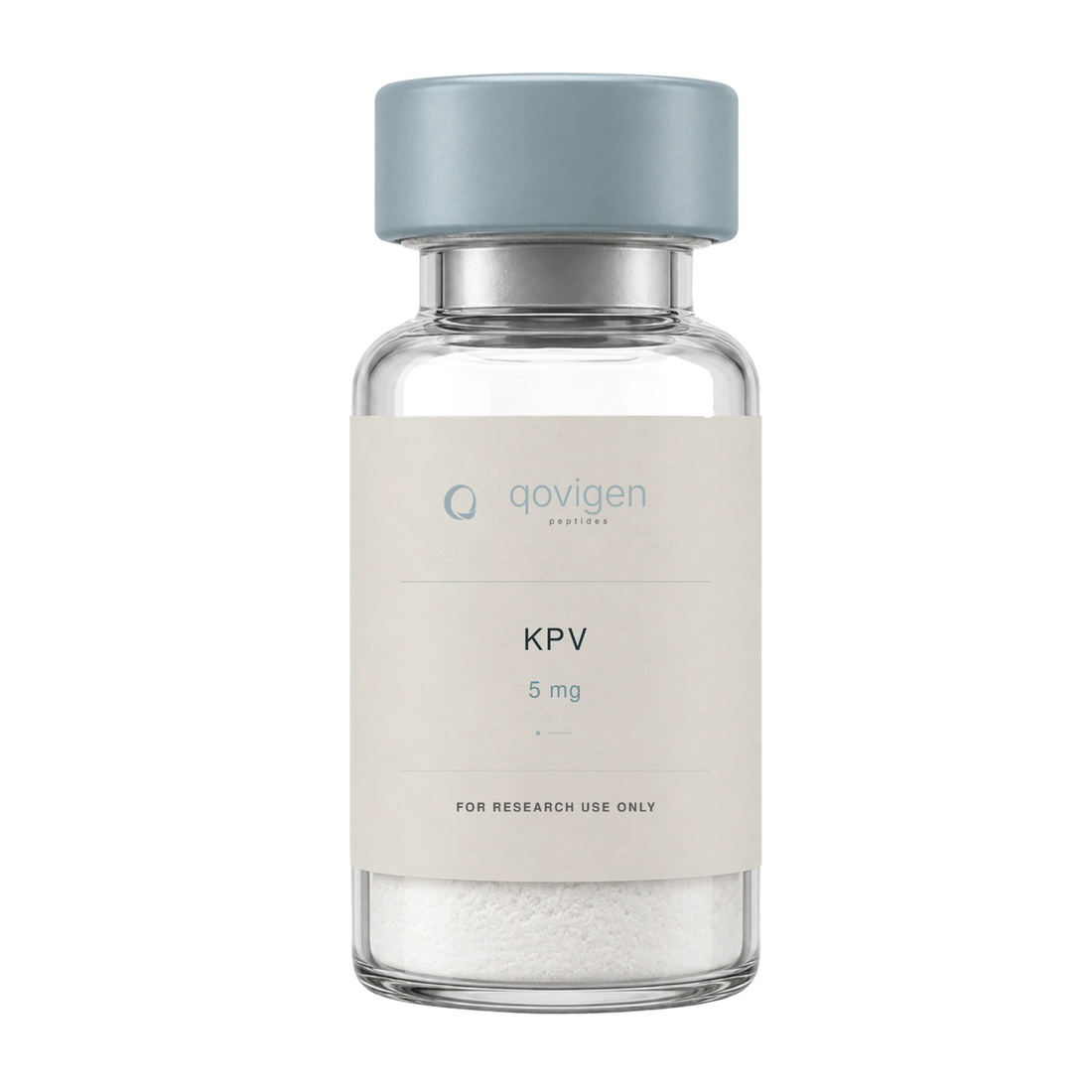
KPV is the tripeptide Lys-Pro-Val, the C-terminal residues 11-13 of α-MSH and the smallest melanocortin fragment reported to retain anti-inflammatory activity.
In gut epithelial and immune cells, KPV enters via the di/tripeptide transporter PepT1; at nanomolar levels it inhibited NF-κB and MAP kinase signaling and cut pro-inflammatory cytokine output[1].
It acts inside the cell, not on surface receptors: in a peritonitis model its anti-migratory effect was not blocked by an MC3/MC4 antagonist; unlike core α-MSH peptides it did not raise cAMP[2]. The record is preclinical.
Supplied as a lyophilized powder for reconstitution. Findings above come from preclinical (animal and cell-based) research on these molecules and are provided as scientific reference for laboratory research only.
Couldn't load pickup availability
Need reconstitution solution? Don’t forget to add Bacteriostatic Water — available as a quick add in your cart before checkout.
C-Terminal Fragment of α-MSH
The Smallest Melanocortin Sequence That Retains Anti-Inflammatory Activity
KPV is the C-terminal tripeptide of α-melanocyte-stimulating hormone — the Lys-Pro-Val sequence corresponding to α-MSH(11-13). It is the shortest melanocortin-derived fragment reported to retain anti-inflammatory activity, and its behaviour is pharmacologically distinct from the core MSH peptides it is derived from.
- Three-residue sequence: Lysine – Proline – Valine
- Corresponds to residues 11–13 of α-MSH
- Smallest reported fragment retaining anti-inflammatory activity
- Distinct profile from core melanocortin peptides
- Active in the nanomolar range in epithelial cell models

PepT1 Uptake & NF-κB Signalling
How KPV Enters the Cell and Dampens Inflammatory Signalling
Unlike larger melanocortins, KPV does not depend on cell-surface melanocortin receptors. It is carried into intestinal epithelial and immune cells by PepT1, the di/tripeptide transporter, and acts intracellularly. Once inside, nanomolar concentrations inhibit NF-κB and MAP kinase signalling and reduce pro-inflammatory cytokine secretion.
- Transported by PepT1 into epithelial and immune cells
- Inhibits NF-κB and MAP kinase inflammatory pathways
- Blocks nuclear import of p65RelA and stabilises IκBα
- Reduces pro-inflammatory cytokine secretion in vitro
- Activity retained in melanocortin-1-receptor-deficient models
Research Applications
From Intestinal Epithelium to Keratinocyte and Airway Models
KPV has been characterised across several preclinical epithelial systems. It has been studied in chemically induced and transfer models of colitis, in human bronchial epithelial cells, and in keratinocyte cultures — alongside dedicated work on its analytical stability and transdermal delivery.
- DSS- and TNBS-induced colitis models in mice
- CD45RB transfer colitis models
- Human intestinal epithelial and T-cell lines
- Immortalised human bronchial epithelial cells
- Human keratinocyte signalling studies
- Stability-indicating HPLC and transdermal delivery research
The Science Behind KPV: A Melanocortin Fragment That Works From Inside the Cell
KPV is a tripeptide made of lysine, proline and valine, corresponding to the C-terminal three residues of α-melanocyte-stimulating hormone. Interest in this fragment comes from a simple observation: it is the smallest piece of the melanocortin sequence that still shows anti-inflammatory activity in laboratory models.
Its mechanism sets it apart from the parent hormone. Work in intestinal epithelial and immune cell lines showed that KPV is taken up by PepT1, the di/tripeptide transporter, and that nanomolar concentrations inhibit NF-κB and MAP kinase signalling while reducing pro-inflammatory cytokine output. Later work in human bronchial epithelium described how this happens: KPV interferes with the nuclear import of p65RelA and stabilises IκBα, keeping the transcription factor out of the nucleus.
Several studies point to a melanocortin-receptor-independent route. In a peritonitis model, the anti-migratory effect of KPV was not blocked by an MC3/4-receptor antagonist and, unlike the core MSH peptides, KPV did not raise cAMP. In colitis models, animals carrying a non-functional melanocortin-1 receptor still responded to KPV treatment.
For research teams working on epithelial inflammation, mucosal barrier models or intracellular NF-κB signalling, KPV offers a small, well-characterised probe with a mechanism that has been described in intestinal, airway and skin cell systems.
For research use only. Not for human consumption.
Scientific Literature
- Dalmasso G, Charrier-Hisamuddin L, Nguyen HTT, Yan Y, Sitaraman S, Merlin D. PepT1-mediated tripeptide KPV uptake reduces intestinal inflammation. Gastroenterology. 2008;134(1):166-78.
- Kannengiesser K, Maaser C, Heidemann J, et al. Melanocortin-derived tripeptide KPV has anti-inflammatory potential in murine models of inflammatory bowel disease. Inflamm Bowel Dis. 2008;14(3):324-31.
- Getting SJ, Schiöth HB, Perretti M. Dissection of the anti-inflammatory effect of the core and C-terminal (KPV) alpha-melanocyte-stimulating hormone peptides. J Pharmacol Exp Ther. 2003;306(2):631-7.
- Land SC. Inhibition of cellular and systemic inflammation cues in human bronchial epithelial cells by melanocortin-related peptides: mechanism of KPV action and a role for MC3R agonists. Int J Physiol Pathophysiol Pharmacol. 2012;4(2):59-73.
- Elliott RJ, Szabo M, Wagner MJ, Kemp EH, MacNeil S, Haycock JW. alpha-Melanocyte-stimulating hormone, MSH 11-13 KPV and adrenocorticotropic hormone signalling in human keratinocyte cells. J Invest Dermatol. 2004;122(4):1010-9.
Packaged with care, shipped fast.
The Qovigen Difference
KPV – 5 mg — Qovigen vs. a typical supplier.
Qovigen

KPV – 5 mg
Qovigen Peptides
Competitor

KPV – 5 mg
Typical Competitor
01 /
Higher Purity
02 /
Better Price
03 /
Faster Shipping
04 /
Verified Quality

After testing more than $8,500 worth of vials over the past year, Qovigen ranks first — set apart by genuinely new production technology.
Dr Aimen Arij
Doctor of Pharmacology · Lead Writer, dosagepeptide.com