


Epithalon (also written Epitalon) is a synthetic tetrapeptide, Ala-Glu-Asp-Gly (AEDG), designed — not isolated — from the amino-acid composition of epithalamin, a bovine pineal extract.
In cultured telomerase-negative human fetal fibroblasts, Epithalon induced expression of the catalytic subunit, telomerase activity and telomere elongation[1].
That record, however, comes almost entirely from a single research group, and a 2025 review of 25 years of work concludes it remains unsettled whether those are the only mechanisms at play[2].
Supplied as a lyophilized powder for reconstitution. Findings above come from preclinical (animal and cell-based) research on these molecules and are provided as scientific reference for laboratory research only.
Couldn't load pickup availability
Need reconstitution solution? Don’t forget to add Bacteriostatic Water — available as a quick add in your cart before checkout.
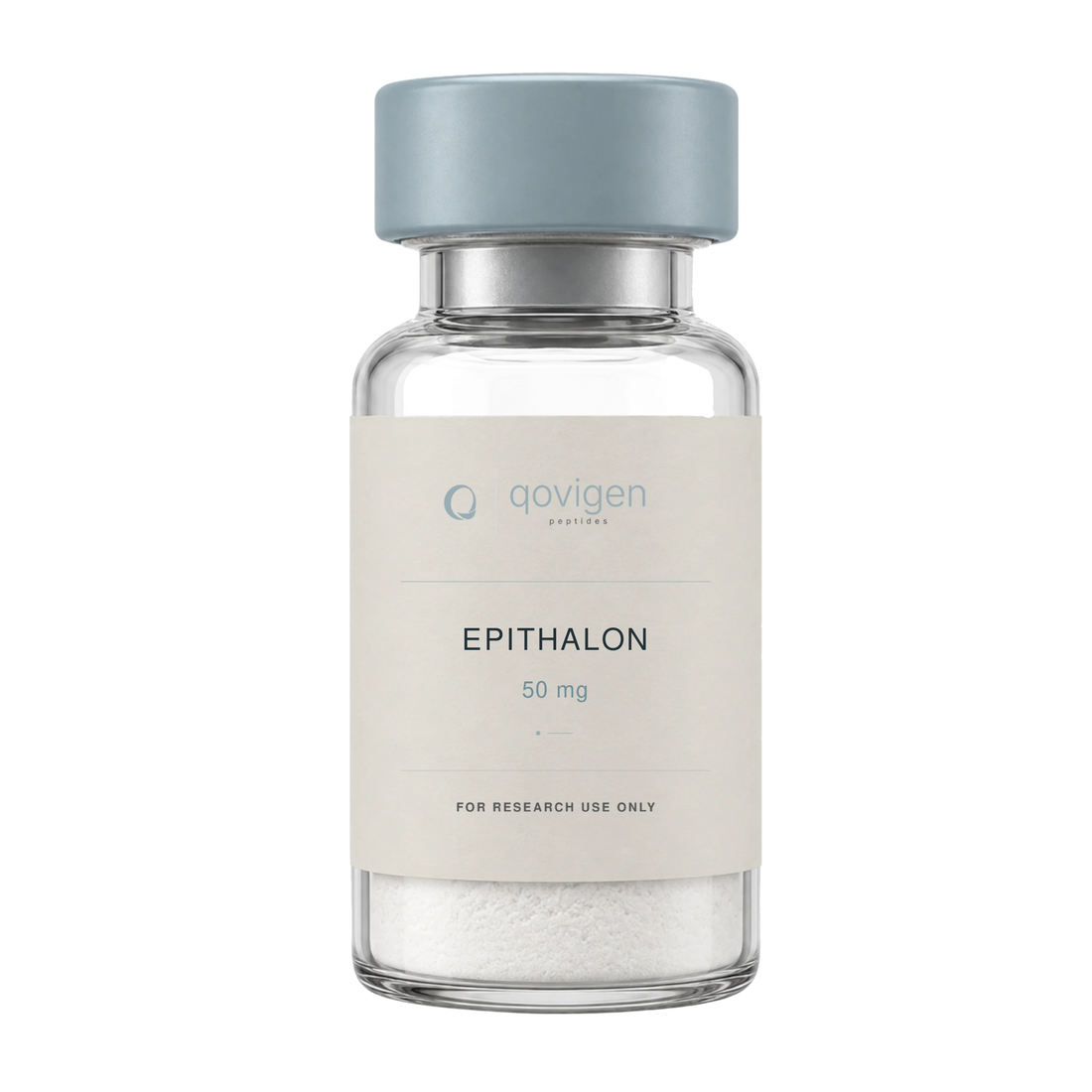
Ala-Glu-Asp-Gly Tetrapeptide
A Four-Residue Peptide Designed From a Pineal Gland Extract
Epithalon — also written Epitalon or AEDG — is a synthetic tetrapeptide with the sequence Ala-Glu-Asp-Gly. It was designed at the St Petersburg Institute of Bioregulation and Gerontology from the amino-acid composition of epithalamin, a bovine pineal gland extract, and has been studied continuously for around twenty-five years.
- Four residues: Alanine – Glutamic acid – Aspartic acid – Glycine
- Derived from the composition of a pineal peptide complex
- The same tetrapeptide was designed for pineal gland and retina
- Studied in vitro, in vivo and in silico across two and a half decades
- Most published work originates from one research group — worth knowing when reading it

Telomerase & Gene Expression
A Short Peptide Proposed to Act at the Level of Transcription
The most cited finding is a 2003 report that Epithalon added to telomerase-negative human fetal fibroblasts induced expression of the catalytic subunit, telomerase activity and telomere elongation. The proposed explanation is unusual for a peptide: direct interaction with DNA and histones rather than a cell-surface receptor.
- Telomerase activity and telomere elongation reported in fibroblast culture
- Candidate binding sites identified in promoter regions by sequence analysis
- Molecular modelling places AEDG at H1/3 and H1/6 histone sites
- Raised Nestin, GAP43, β-Tubulin III and Doublecortin mRNA in human stem cells
- A 2025 review notes the full mechanism is still not settled
Research Applications
Cell Senescence, Circadian Endocrinology and Retinal Models
Published work sits across cell culture, rodent and primate models. Two lines recur: markers of replicative senescence in cultured stem cells, and the night-time melatonin rhythm in aged animals.
- p16 and p21 senescence markers in human periodontal ligament and gingival stem cells
- Long-term expansion of primary mesenchymal stem cell cultures
- Night melatonin, glucose and insulin dynamics in old rhesus monkeys
- Neurogenic differentiation markers in human stem cell cultures
- Retinal models in Campbell rats with hereditary pigmentary degeneration
- Post-ovulatory mouse oocyte models measuring ROS and mitochondrial potential
The Science Behind Epithalon: A Tetrapeptide Studied as a Transcriptional Regulator
Epithalon is a synthetic tetrapeptide, Ala-Glu-Asp-Gly. It was not isolated from tissue but designed: researchers analysed the amino-acid composition of epithalamin, a peptide complex extracted from the bovine pineal gland, and built a short sequence intended to reproduce its activity.
The finding that made it well known came in 2003, when addition of the peptide to telomerase-negative human fetal fibroblasts was reported to induce expression of the telomerase catalytic subunit, enzymatic activity and telomere elongation. A companion paper the same year proposed the mechanism: that short regulatory peptides bind directly to promoter regions and initiate transcription. Later molecular modelling extended this idea to histones, identifying probable AEDG contact sites on H1/3 and H1/6 in regions that interact with DNA.
In cultured human stem cells, AEDG treatment lowered expression of the senescence markers p16 and p21 at passage 25 relative to untreated controls, and raised several neurogenic differentiation markers. In old rhesus monkeys, administration was associated with higher basal night melatonin and altered glucose and insulin dynamics, with no equivalent effect in young animals.
Two things are worth stating plainly. First, the large majority of this literature comes from a single research group, and a 2025 review in International Journal of Molecular Sciences concluded that it remains uncertain whether the described mechanisms are the only ones at work. Second, the physico-chemical and structural characterisation of the peptide is, by that review's own assessment, still limited compared with the volume of biological work.
For laboratories working on replicative senescence, telomere biology, short-peptide/DNA interaction or circadian endocrinology in ageing models, Epithalon is the reference AEDG tetrapeptide.
For research use only. Not for human consumption.
Scientific Literature
- Khavinson VKh, Bondarev IE, Butyugov AA. Epithalon peptide induces telomerase activity and telomere elongation in human somatic cells. Bull Exp Biol Med. 2003;135(6):590-2.
- Khavinson VKh, Shataeva LK, Chernova AA. Effect of regulatory peptides on gene transcription. Bull Exp Biol Med. 2003;136(3):288-90.
- Khavinson V, Diomede F, Mironova E, et al. AEDG peptide (Epitalon) stimulates gene expression and protein synthesis during neurogenesis: possible epigenetic mechanism. Molecules. 2020;25(3):609.
- Sinjari B, Diomede F, Khavinson V, et al. Short peptides protect oral stem cells from ageing. Stem Cell Rev Rep. 2020;16(1):159-66.
- Araj SK, Brzezik J, Mądra-Gackowska K, Szeleszczuk Ł. Overview of Epitalon — highly bioactive pineal tetrapeptide with promising properties. Int J Mol Sci. 2025;26(6):2691.
Packaged with care, shipped fast.
The Qovigen Difference
Epithalon – 50 mg — Qovigen vs. a typical supplier.
Qovigen

Epithalon – 50 mg
Qovigen Peptides
Competitor

Epithalon – 50 mg
Typical Competitor
01 /
Higher Purity
02 /
Better Price
03 /
Faster Shipping
04 /
Verified Quality

After testing more than $8,500 worth of vials over the past year, Qovigen ranks first — set apart by genuinely new production technology.
Dr Aimen Arij
Doctor of Pharmacology · Lead Writer, dosagepeptide.com