


DSIP (Delta Sleep-Inducing Peptide) is a nonapeptide isolated in 1977 from rabbit cerebral venous blood and named for an effect that has never been characterized.
In that first report, nine synthetic peptides were perfused intraventricularly in a double-blind design across 58 rabbits; only the intact nonapeptide raised delta traces and EEG spindles, not its five metabolic fragments or two substituted analogs[1].
A 2006 review calls DSIP "a still unresolved riddle" — no gene, no precursor protein and no receptor have been isolated, and DSIP-like immunoreactivity maps to hypothalamic nuclei of little relevance to sleep[2].
Supplied as a lyophilized powder for reconstitution. Figures above summarize published preclinical (animal and cell-based) research on this molecule and are provided as scientific reference for laboratory research only.
Couldn't load pickup availability
Need reconstitution solution? Don’t forget to add Bacteriostatic Water — available as a quick add in your cart before checkout.
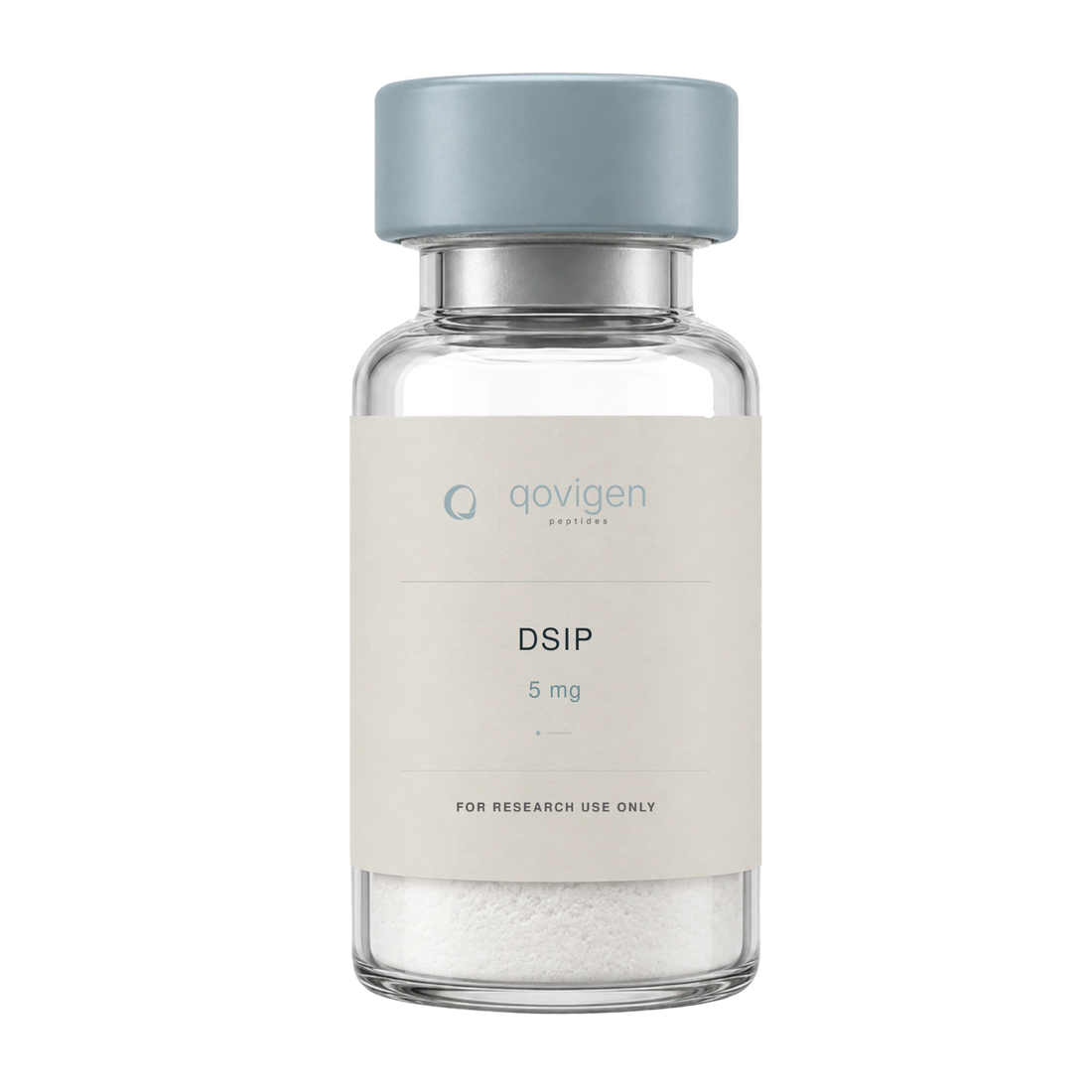
Nonapeptide, Isolated 1977
A Nine-Residue Peptide Named After a Hypothesis
DSIP is a nonapeptide with the sequence Trp-Ala-Gly-Gly-Asp-Ala-Ser-Gly-Glu. It was isolated from rabbit cerebral venous blood in 1977 by Schoenenberger and Monnier, who named it for the effect they observed: enhancement of delta and spindle patterns on the electroencephalogram after intraventricular infusion.
- Nine residues, sequence published in PNAS in 1977
- Isolated from rabbit cerebral venous blood
- Original assay: EEG delta and spindle enhancement in 58 rabbits
- Its structure resembles no other known peptide family
- Five metabolic fragments and two analogues were synthesised alongside it — only the intact nonapeptide was active

An Honest Reading of the Literature
The Name Says Sleep. The Evidence Has Never Settled It.
This is a peptide worth describing carefully. A 2006 review in the Journal of Neurochemistry called DSIP “a still unresolved riddle” and stated plainly that the link between DSIP and sleep has never been properly characterised. No DSIP gene, precursor protein or receptor has been isolated.
- No gene, precursor or receptor identified to date
- DSIP-like immunoreactivity maps to hypothalamic nuclei not obviously tied to sleep
- Certain synthetic analogues promoted slow-wave sleep — DSIP itself did not
- The review authors proposed an unidentified DSIP-like peptide as the real actor
- A broad spectrum of in-vitro activity has been reported without a unifying mechanism
Research Applications
Where DSIP Is Actually Being Used Today
Recent work has moved away from the sleep question and toward rodent injury and hypoxia models, plus protein-engineering studies aimed at getting the peptide across biological barriers.
- Intranasal dosing in rats after middle cerebral artery occlusion, with rotarod motor testing
- Phosphorylated DSIP in simulated high-altitude hypobaric hypoxia at 7 620 m
- Telemetric EEG recording of NREM and REM architecture in rats
- Morris water maze performance and hippocampal CREB phosphorylation
- Fusion constructs with a transduction domain and human serum albumin, expressed in Pichia pastoris
- Entrapment in charged macroporous polymer matrices for controlled release

The Science Behind DSIP: A Well-Known Name and an Open Question
DSIP — delta sleep-inducing peptide — is a nonapeptide, Trp-Ala-Gly-Gly-Asp-Ala-Ser-Gly-Glu. It was isolated in 1977 from the cerebral venous blood of rabbits, and the original PNAS paper is a careful piece of work: nine synthetic peptides, including five metabolic fragments and two substituted analogues, were infused intraventricularly under double-blind conditions across 58 rabbits. Only the intact nonapeptide produced significant delta and spindle enhancement.
What happened next is the interesting part. Nearly fifty years on, no DSIP gene has been isolated, no precursor protein identified, and no receptor characterised. A 2006 review described the sleep hypothesis as “extremely poorly documented and still weak”, and noted an awkward detail: certain artificial structural analogues of DSIP promoted slow-wave sleep in rabbits and rats, while DSIP itself did not. The authors proposed that a distinct, still-unidentified DSIP-like peptide may account for both the immunoreactivity and the biological activity attributed to DSIP.
Current research largely sidesteps the sleep question. A 2021 study administered DSIP intranasally to rats before and after middle cerebral artery occlusion; infarct volume was not significantly reduced, but rotarod motor performance recovered significantly — the authors reported both results. A 2018 study used a phosphorylated form during simulated high-altitude hypoxia and measured sleep architecture telemetrically alongside spatial memory and hippocampal CREB phosphorylation.
We stock DSIP because it is a legitimate and long-standing research peptide with a clean synthetic history. We describe it this way because the literature does. For laboratories working on EEG sleep architecture, neuropeptide identification, or CNS delivery of short peptides, DSIP remains an open and genuinely interesting problem.
For research use only. Not for human consumption.
Scientific Literature
- Schoenenberger GA, Monnier M. Characterization of a delta-electroencephalogram (-sleep)-inducing peptide. Proc Natl Acad Sci U S A. 1977;74(3):1282-6.
- Kovalzon VM, Strekalova TV. Delta sleep-inducing peptide (DSIP): a still unresolved riddle. J Neurochem. 2006;97(2):303-9.
- Tukhovskaya EA, Ismailova AM, Shaykhutdinova ER, et al. Delta sleep-inducing peptide recovers motor function in SD rats after focal stroke. Molecules. 2021;26(17):5173.
- Roy K, Chauhan G, Kumari P, et al. Phosphorylated delta sleep inducing peptide restores spatial memory and p-CREB expression by improving sleep architecture at high altitude. Life Sci. 2018;209:282-90.
- Zhang XG, Wang WN, Zhang CS, Li K, Ma GD, Li JY. Expression and purification of delta sleep-inducing peptide fused with protein transduction domain and human serum albumin in Pichia pastoris. Protein Pept Lett. 2017;24(7):668-75.
Packaged with care, shipped fast.
The Qovigen Difference
DSIP – 5 mg — Qovigen vs. a typical supplier.
Qovigen

DSIP – 5 mg
Qovigen Peptides
Competitor

DSIP – 5 mg
Typical Competitor
01 /
Higher Purity
02 /
Better Price
03 /
Faster Shipping
04 /
Verified Quality

After testing more than $8,500 worth of vials over the past year, Qovigen ranks first — set apart by genuinely new production technology.
Dr Aimen Arij
Doctor of Pharmacology · Lead Writer, dosagepeptide.com