


Cagrilintide is a long-acting analog of amylin — a pancreatic satiety hormone — acting on the amylin receptor. It works through a satiety pathway that is distinct from, and complementary to, GLP-1, which is why it is widely studied both alone and stacked with GLP-1 agonists.
In a 26-week Phase 2 obesity trial, cagrilintide 4.5 mg produced a mean body-weight reduction of 10.8%, versus 3.0% on placebo — and it outperformed liraglutide 3.0 mg (10.8% vs 9.0%)[1].
Its most-studied use is in combination: co-administered with semaglutide (CagriSema), weight loss reached 15.6% at 32 weeks — far beyond semaglutide alone (5.1%)[2].
Supplied as a lyophilized powder for reconstitution. Figures above summarize published clinical findings on the cagrilintide molecule and are provided as scientific reference for laboratory research only.
Couldn't load pickup availability
Need reconstitution solution? Don’t forget to add Bacteriostatic Water — available as a quick add in your cart before checkout.
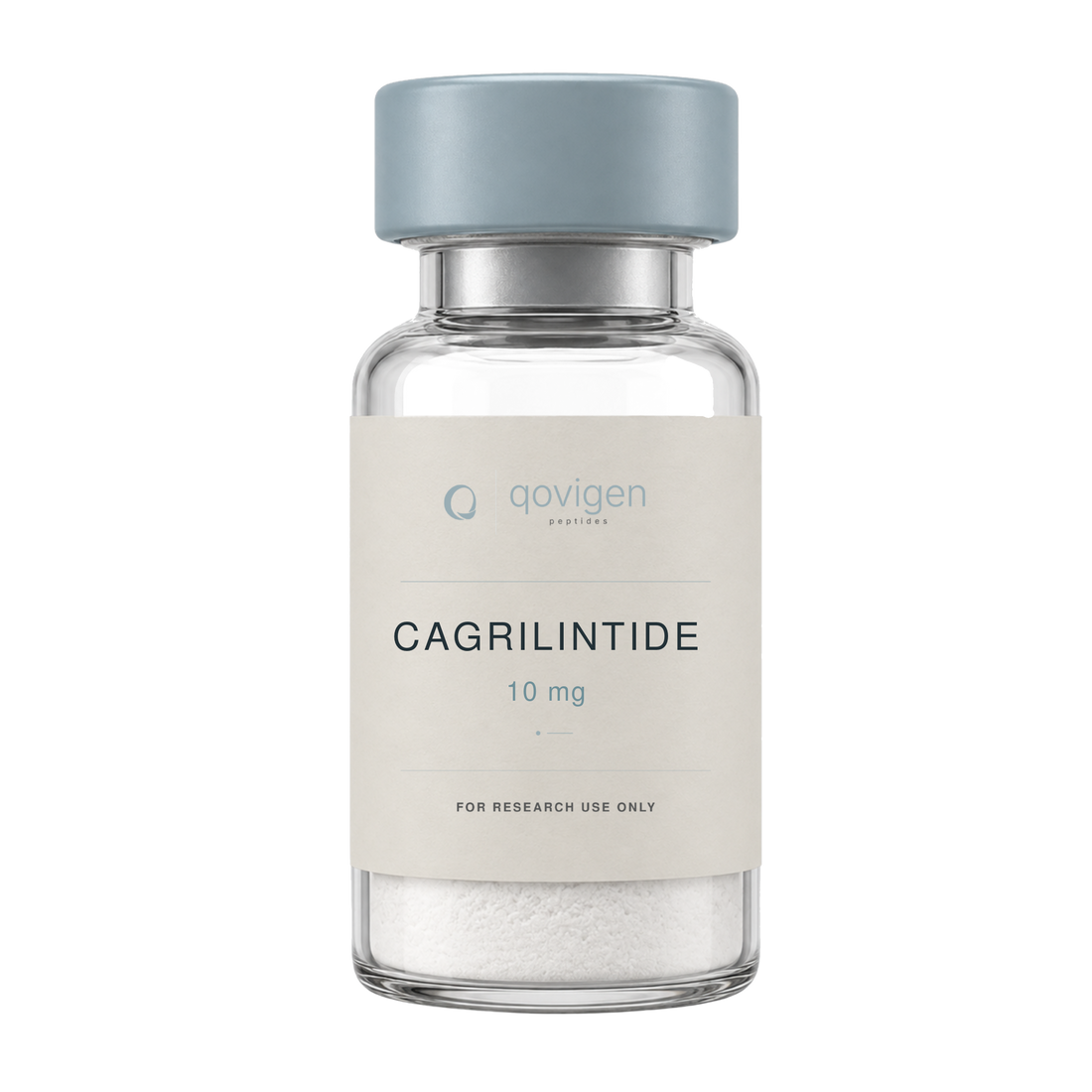
Long-Acting Amylin Analogue
A New Pathway for Satiety and Metabolic Research
Cagrilintide is a long-acting acylated amylin analogue designed to activate central amylin receptors — a distinct satiety pathway separate from GLP-1. With an extended half-life of approximately 160–195 hours, Cagrilintide enables convenient weekly research protocols while providing sustained receptor engagement for comprehensive metabolic studies.
- Long-acting amylin receptor agonist
- Extended half-life (~160–195 hours) supports weekly protocols
- Distinct satiety pathway from GLP-1 agonists
- Acylated structure for enhanced stability
- High purity for reliable research outcomes

Central Amylin Signaling
How Cagrilintide Modulates Appetite and Metabolism
Cagrilintide mimics native amylin — a hormone co-secreted with insulin from pancreatic beta cells. By acting on central amylin receptors in the area postrema and hindbrain, it promotes satiation, slows gastric emptying, and inhibits postprandial glucagon secretion. This mechanism offers a complementary pathway to GLP-1 agonists for metabolic research.
- Activates area postrema and hindbrain amylin receptors
- Promotes satiation and reduces food intake
- Slows gastric emptying for nutrient timing studies
- Inhibits postprandial glucagon secretion
- Complementary mechanism to GLP-1 pathways
Research Applications
From Satiety Studies to Combination Metabolic Research
Cagrilintide has emerged as a key compound for researchers investigating multi-pathway metabolic interventions. Its distinct mechanism makes it ideal for combination studies with GLP-1 agonists like Semaglutide — exploring synergistic effects on appetite, glucose control, and energy balance that neither pathway achieves alone.
- Satiety and appetite regulation studies
- Combination research with GLP-1 agonists
- Gastric emptying and nutrient absorption modeling
- Glucagon suppression and glycemic research
- Beta-cell function and insulin co-secretion studies
- Long-duration metabolic monitoring protocols

The Science Behind Amylin: Why Cagrilintide Opens New Research Frontiers
Cagrilintide represents a significant advancement in metabolic research tools. As a long-acting amylin analogue, it targets a satiety pathway that operates independently of — and complementary to — the GLP-1 system. This distinction makes it invaluable for researchers exploring multi-receptor approaches to metabolic regulation.
Native amylin is co-secreted with insulin from pancreatic beta cells after meals. It acts centrally to reduce appetite, slow gastric emptying, and suppress glucagon release. Cagrilintide's acylated structure extends these effects over approximately 160–195 hours — enabling weekly research protocols while maintaining consistent receptor activation.
What makes Cagrilintide particularly compelling is its synergistic potential with GLP-1 agonists. By targeting distinct but complementary pathways, combination approaches may achieve metabolic effects that exceed either mechanism alone. This has made Cagrilintide central to next-generation metabolic combination research.
For research teams investigating satiety mechanisms, glucose homeostasis, or multi-pathway metabolic interventions, Cagrilintide provides access to the amylin system with the pharmacokinetic profile needed for sustained, practical research protocols.
For research use only. Not for human consumption.
Scientific Literature
- Lau DCW, Erichsen L, Francisco AM, Satylganova A, le Roux CW, McGowan B, Pedersen SD, Pietiläinen KH, Rubino D, Batterham RL. Once-weekly cagrilintide for weight management in people with overweight and obesity: a multicentre, randomised, double-blind, placebo-controlled and active-controlled, dose-finding phase 2 trial. Lancet. 2021;398(10317):2160-2172.
- Frias JP, Deenadayalan S, Erichsen L, Knop FK, Lingvay I, Macura S, Mathieu C, Pedersen SD, Davies M. Efficacy and safety of co-administered once-weekly cagrilintide 2·4 mg with once-weekly semaglutide 2·4 mg in type 2 diabetes: a multicentre, randomised, double-blind, active-controlled, phase 2 trial. Lancet. 2023;402(10403):720-730.
Packaged with care, shipped fast.
The Qovigen Difference
Cagrilintide 10 mg — Qovigen vs. a typical supplier.
Qovigen

Cagrilintide – 10 mg
Qovigen Peptides
Competitor

Cagrilintide – 10 mg
Typical Competitor
01 /
Higher Purity
02 /
Better Price
03 /
Faster Shipping
04 /
Verified Quality

After testing more than $8,500 worth of vials over the past year, Qovigen ranks first — set apart by genuinely new production technology.
Dr Aimen Arij
Doctor of Pharmacology · Lead Writer, dosagepeptide.com