


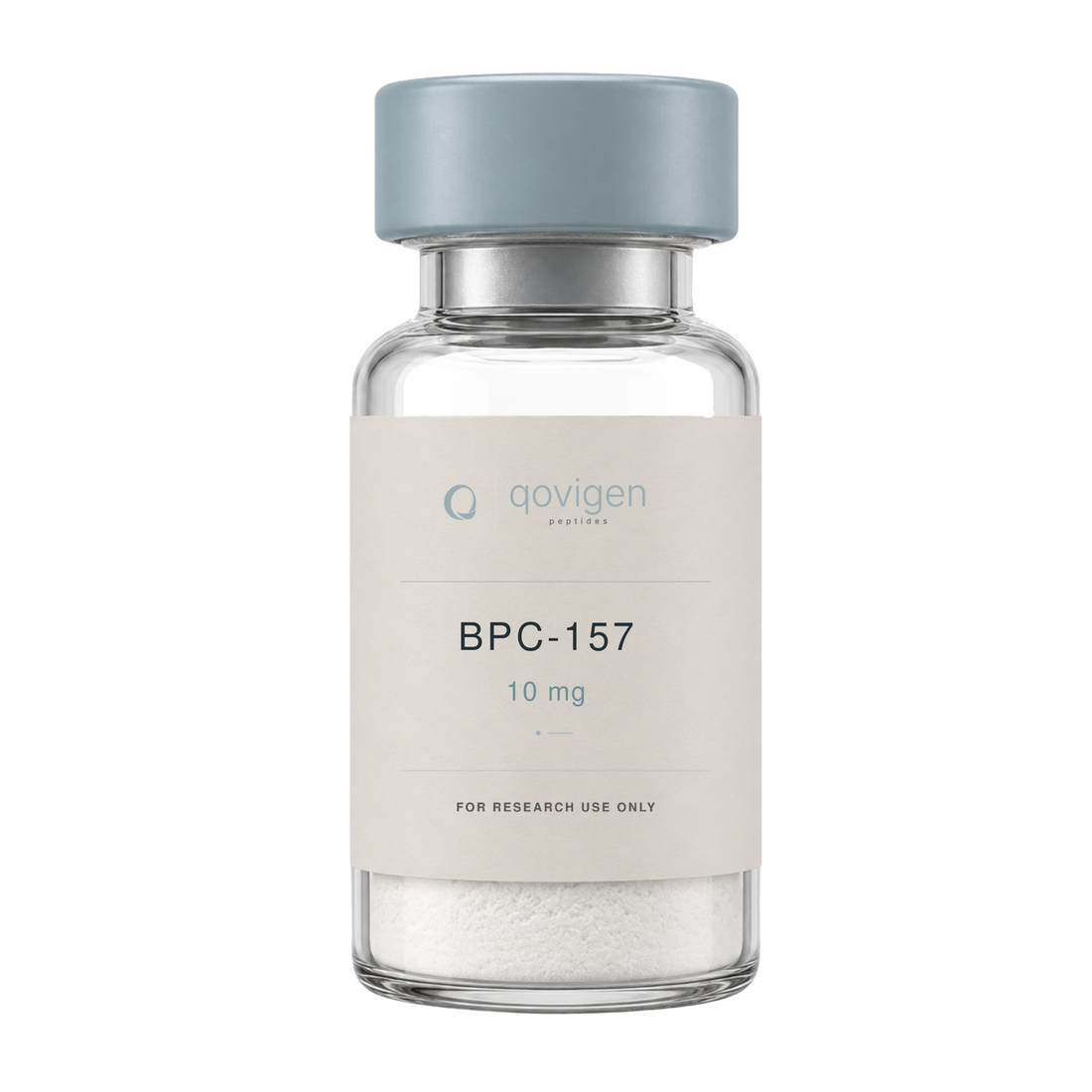
BPC-157 (Body Protection Compound) is a stable pentadecapeptide derived from a protein found in gastric juice, studied for its broad tissue-repair activity across tendon, ligament, gut and vascular tissue.
In preclinical research, BPC-157 accelerated the outgrowth and migration of tendon fibroblasts and improved their survival under oxidative stress, via the FAK–paxillin pathway[1].
It is also strongly pro-angiogenic: in rat and endothelial-cell models it promoted new blood-vessel formation and blood-flow recovery by up-regulating the VEGFR2–Akt–eNOS pathway[2].
Supplied as a lyophilized powder for reconstitution. Findings above come from preclinical (animal and cell-based) research on these molecules and are provided as scientific reference for laboratory research only.
Couldn't load pickup availability
Need reconstitution solution? Don’t forget to add Bacteriostatic Water — available as a quick add in your cart before checkout.
Cytoprotective Gastric Peptide
The Body's Natural Repair Signal — Now Available for Research
BPC-157 (Body Protection Compound-157) is a synthetic 15-amino-acid peptide derived from a protective protein found in human gastric juice. Extensively studied for its remarkable tissue-healing and cytoprotective properties, BPC-157 has become one of the most researched regenerative peptides in preclinical science. Its broad healing profile spans gut, tendon, muscle, and beyond.
- 15-amino-acid sequence derived from gastric protein
- Extensively studied in preclinical tissue repair models
- Cytoprotective and anti-inflammatory properties
- Stable in gastric acid — unique among peptides
- High purity (≥99%) for reliable research outcomes

Multi-Pathway Healing Mechanism
How BPC-157 Orchestrates Tissue Repair
BPC-157 activates multiple healing pathways simultaneously. It promotes angiogenesis by increasing VEGF expression, enhances nitric oxide production for improved blood flow, and upregulates growth factor receptors (including ERK1/2 and AKT signaling) in damaged tissue. Simultaneously, it suppresses pro-inflammatory markers like IL-6, TNF-α, and COX-2 — creating an optimal environment for repair.
- Promotes angiogenesis via VEGF upregulation
- Enhances nitric oxide synthesis for vasodilation
- Activates ERK1/2 and AKT growth pathways
- Suppresses IL-6, TNF-α, and COX-2 inflammation
- Modulates serotonin and dopamine systems
Research Applications
From Gut to Tendon — Versatile Tissue Repair Research
BPC-157 has demonstrated healing effects across remarkably diverse tissue types in preclinical models. Its gastric origin makes it particularly effective for gut-related research, while its broad mechanism supports investigations into tendon, ligament, muscle, and even neurological repair. This versatility has made BPC-157 a cornerstone of regenerative peptide research.
- Gastrointestinal healing and ulcer repair studies
- Tendon and ligament regeneration modeling
- Muscle injury and recovery research
- Wound healing and skin repair investigations
- Neuroprotective pathway exploration
- Anti-inflammatory mechanism studies
The Science Behind Body Protection: Why BPC-157 Leads Regenerative Research
BPC-157 has earned its reputation as a "Swiss Army knife" of tissue repair. This 15-amino-acid peptide, originally isolated from human gastric juice, has demonstrated healing effects in virtually every tissue type studied — from the gut lining to tendons, muscles, bones, and even the nervous system.
What makes BPC-157 remarkable is its multi-pathway approach to healing. Rather than targeting a single mechanism, it simultaneously promotes blood vessel formation (angiogenesis), enhances growth factor signaling, increases nitric oxide for better tissue oxygenation, and suppresses inflammatory markers. This coordinated response mimics and amplifies the body's natural repair processes.
Uniquely among peptides, BPC-157 is stable in gastric acid — a property that reflects its origin and enables oral research applications. This stability, combined with its broad tissue applicability, has made it one of the most extensively studied regenerative peptides in preclinical science.
For research teams investigating wound healing, tissue regeneration, or anti-inflammatory pathways, BPC-157 provides a well-characterized platform with extensive preclinical literature. Its versatility and proven mechanism make it essential for modern regenerative medicine research.
For research use only. Not for human consumption.
Scientific Literature
- Chang CH, Tsai WC, Lin MS, Hsu YH, Pang JH. The promoting effect of pentadecapeptide BPC 157 on tendon healing involves tendon outgrowth, cell survival, and cell migration. J Appl Physiol (1985). 2011;110(3):774-80.
- Hsieh MJ, Liu HT, Wang CN, Huang HY, Lin Y, Ko YS, Wang JS, Chang VH, Pang JS. Therapeutic potential of pro-angiogenic BPC157 is associated with VEGFR2 activation and up-regulation. J Mol Med (Berl). 2016;95(3):323-333.
Packaged with care, shipped fast.
The Qovigen Difference
BPC-157 – 10 mg — Qovigen vs. a typical supplier.
Qovigen

BPC-157 – 10 mg
Qovigen Peptides
Competitor

BPC-157 – 10 mg
Typical Competitor
01 /
Higher Purity
02 /
Better Price
03 /
Faster Shipping
04 /
Verified Quality

After testing more than $8,500 worth of vials over the past year, Qovigen ranks first — set apart by genuinely new production technology.
Dr Aimen Arij
Doctor of Pharmacology · Lead Writer, dosagepeptide.com