


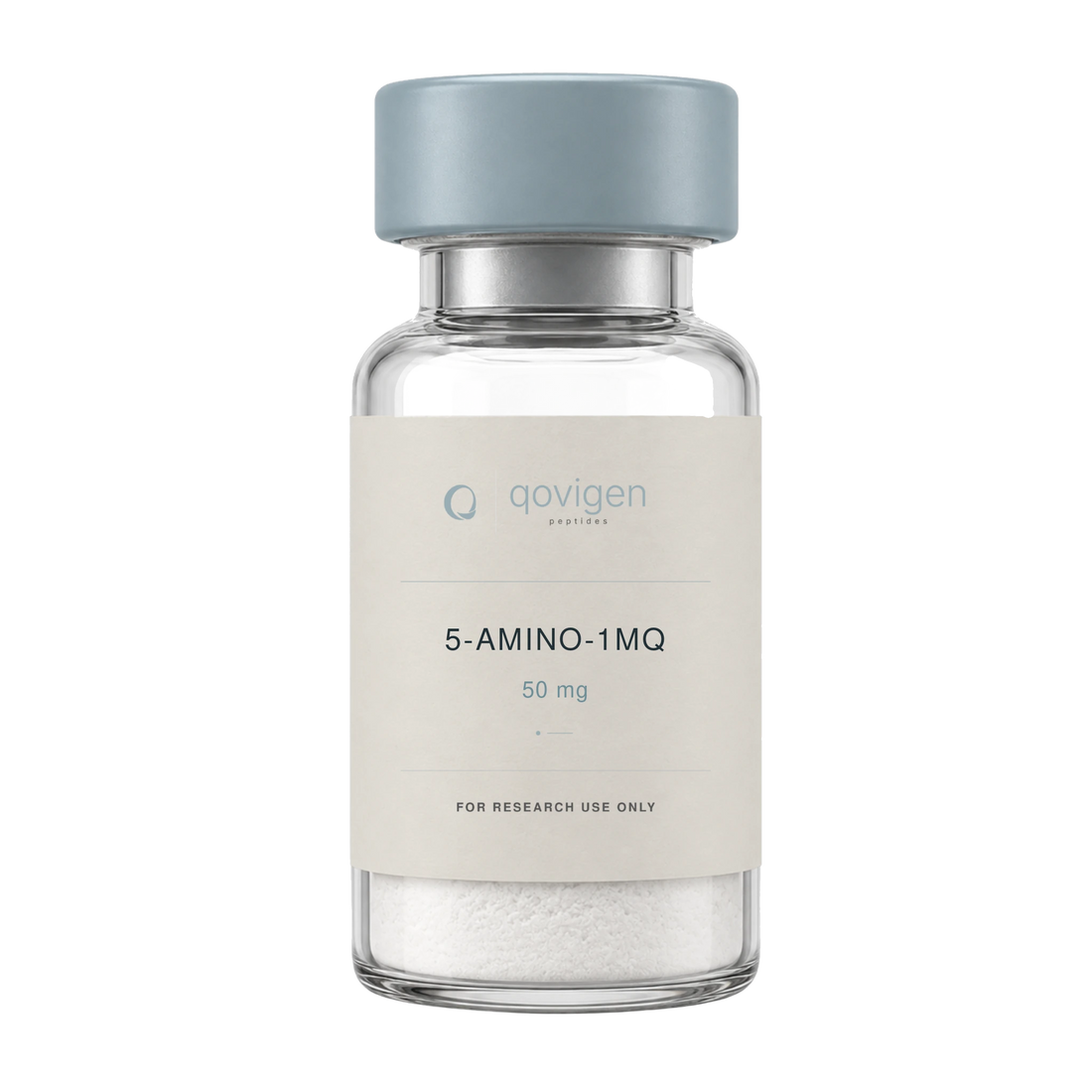
5-Amino-1MQ (5-amino-1-methylquinolinium), catalogued here alongside peptides, is not a peptide but a small quinolinium molecule that inhibits nicotinamide N-methyltransferase (NNMT).
In 24-month-old mice given an NNMT inhibitor after muscle injury, myofiber cross-sectional area reached about 2× that of controls, and peak tibialis anterior torque was about 70% higher[1].
NNMT methylates nicotinamide using S-adenosylmethionine, draining both a NAD+ precursor and the universal methyl donor. Nnmt knockdown in mouse white adipose tissue and liver protected from diet-induced obesity, raising SAM and adipose NAD+[2].
Supplied as a lyophilized powder for reconstitution. Figures above summarize published preclinical (animal and cell-based) research on NNMT inhibition and are provided as scientific reference for laboratory research only.
Couldn't load pickup availability
Need reconstitution solution? Don’t forget to add Bacteriostatic Water — available as a quick add in your cart before checkout.
Small-Molecule NNMT Inhibitor
A Quinolinium Compound Built to Block a Single Metabolic Enzyme
5-Amino-1MQ is 5-amino-1-methylquinolinium — a small, membrane-permeable molecule rather than a peptide. It was developed as a research inhibitor of nicotinamide N-methyltransferase (NNMT), the enzyme that transfers a methyl group from S-adenosylmethionine onto nicotinamide.
- Quinolinium scaffold, not an amino-acid sequence
- Targets nicotinamide N-methyltransferase (NNMT)
- Membrane-permeable, active in whole-cell assays
- NNMT is over-expressed in adipose tissue and liver of obese and diabetic mice
- Used in rodent metabolic and muscle-regeneration studies

NAD Salvage & the Methyl Pool
One Enzyme Sitting Between Two Metabolic Currencies
NNMT consumes two things at once: nicotinamide, a precursor of NAD+, and S-adenosylmethionine, the cell's universal methyl donor. Its products are methylnicotinamide and S-adenosylhomocysteine. Inhibiting the enzyme is therefore studied as a way to spare both substrates simultaneously.
- Nicotinamide is diverted away from the NAD+ salvage pathway by NNMT
- S-adenosylmethionine is the methyl donor consumed in the reaction
- Nnmt knockdown raised adipose SAM and NAD+ in mice (Nature, 2014)
- Reported downstream effects on H3K4 methylation and polyamine flux
- Methylnicotinamide itself is secreted by human myotubes and stimulates lipolysis in vitro
Research Applications
From Diet-Induced Obese Mice to Aged Skeletal Muscle
Published work using 5-amino-1-methylquinolinium sits in two main areas: rodent metabolic models and muscle stem cell biology. Both lines of research came out of the same observation — that NNMT expression rises with obesity and with age.
- Diet-induced obese (DIO) mouse models, alone and combined with a reduced-calorie diet
- Cecal microbiome profiling in treated DIO mice
- Muscle stem cell proliferation and fusion in 24-month-old mice after acute injury
- C2C12 myoblast differentiation and cellular NAD/NADH redox state
- 3T3-L1 adipocyte cultures for NNMT expression regulation
- Cell-line work on NNMT inhibition and Akt/SIRT1 protein expression
The Science Behind 5-Amino-1MQ: Blocking the Enzyme That Spends Nicotinamide
5-Amino-1MQ (5-amino-1-methylquinolinium) is a small-molecule enzyme inhibitor. It is worth stating plainly, because it is often catalogued alongside peptides: this compound is not a peptide and has no amino-acid sequence. Its interest comes entirely from a single target — nicotinamide N-methyltransferase.
NNMT sits at an awkward junction in cellular metabolism. It methylates nicotinamide, which means it simultaneously drains a precursor of NAD+ and a molecule of S-adenosylmethionine, the methyl donor used across the cell for histone and DNA methylation. The landmark 2014 paper in Nature showed that knocking down Nnmt in white adipose tissue and liver protected mice against diet-induced obesity by raising cellular energy expenditure, with measurable increases in adipose SAM and NAD+ and changes in polyamine flux and H3K4 methylation.
Small-molecule inhibitors followed. In a 2019 study, aged mice (24 months) treated with an NNMT inhibitor after acute muscle injury showed increased muscle stem cell proliferation and fusion, roughly twice the myofiber cross-sectional area of controls, and around 70% greater peak torque in the injured muscle. The same work reproduced the effect in C2C12 myoblasts, with corresponding shifts in the NAD/NADH redox state.
Other studies have looked at what regulates the enzyme in the first place: glucose deprivation doubles NNMT expression in 3T3-L1 adipocytes through an mTOR-dependent mechanism, and in humans NNMT was the most consistently upregulated muscle gene after four days of combined caloric restriction and exercise — with plasma methylnicotinamide doubling in parallel.
For laboratories working on NAD+ metabolism, methyl-group availability, adipocyte energy expenditure or muscle stem cell senescence, 5-Amino-1MQ is the reference tool compound for interrogating NNMT.
For research use only. Not for human consumption.
Scientific Literature
- Kraus D, Yang Q, Kong D, et al. Nicotinamide N-methyltransferase knockdown protects against diet-induced obesity. Nature. 2014;508(7495):258-62.
- Neelakantan H, Brightwell CR, Graber TG, et al. Small molecule nicotinamide N-methyltransferase inhibitor activates senescent muscle stem cells and improves regenerative capacity of aged skeletal muscle. Biochem Pharmacol. 2019;163:481-92.
- Dimet-Wiley A, Wu Q, Wiley JT, et al. Reduced calorie diet combined with NNMT inhibition establishes a distinct microbiome in DIO mice. Sci Rep. 2022;12(1):484.
- Ström K, Morales-Alamo D, Ottosson F, et al. N-methylnicotinamide is a signalling molecule produced in skeletal muscle coordinating energy metabolism. Sci Rep. 2018;8(1):3016.
- Ehebauer F, Ghavampour S, Kraus D. Glucose availability regulates nicotinamide N-methyltransferase expression in adipocytes. Life Sci. 2020;248:117474.
Packaged with care, shipped fast.
The Qovigen Difference
5-Amino-1MQ – 50 mg — Qovigen vs. a typical supplier.
Qovigen

5-Amino-1MQ – 50 mg
Qovigen Peptides
Competitor

5-Amino-1MQ – 50 mg
Typical Competitor
01 /
Higher Purity
02 /
Better Price
03 /
Faster Shipping
04 /
Verified Quality

After testing more than $8,500 worth of vials over the past year, Qovigen ranks first — set apart by genuinely new production technology.
Dr Aimen Arij
Doctor of Pharmacology · Lead Writer, dosagepeptide.com