


2X Blend – Tesamorelin + Ipamorelin – 13 mg / 3 mg
2X Blend – Tesamorelin + Ipamorelin – 13 mg / 3 mg
2X Blend is tesamorelin 13 mg with ipamorelin 3 mg in one vial — deliberately not 50/50 but weighted to the GHRH arm, ipamorelin at about a fifth of the tesamorelin dose.
Tesamorelin holds the heavier human record: in a 412-participant randomized trial, CT-measured visceral adipose tissue fell 15.2% in 26 weeks against a 5.0% rise on placebo[1].
Separate receptors, one target cell: tesamorelin on the GHRH receptor, ipamorelin on the somatotroph's ghrelin receptor (GHS-R). Evidence differs: ipamorelin was profiled in rats and pigs, raising neither ACTH nor cortisol[2].
Supplied as a lyophilized powder for reconstitution. Figures above summarize published clinical and preclinical animal research on these molecules and are provided as scientific reference for laboratory research only.
Couldn't load pickup availability
Need reconstitution solution? Don’t forget to add Bacteriostatic Water — available as a quick add in your cart before checkout.
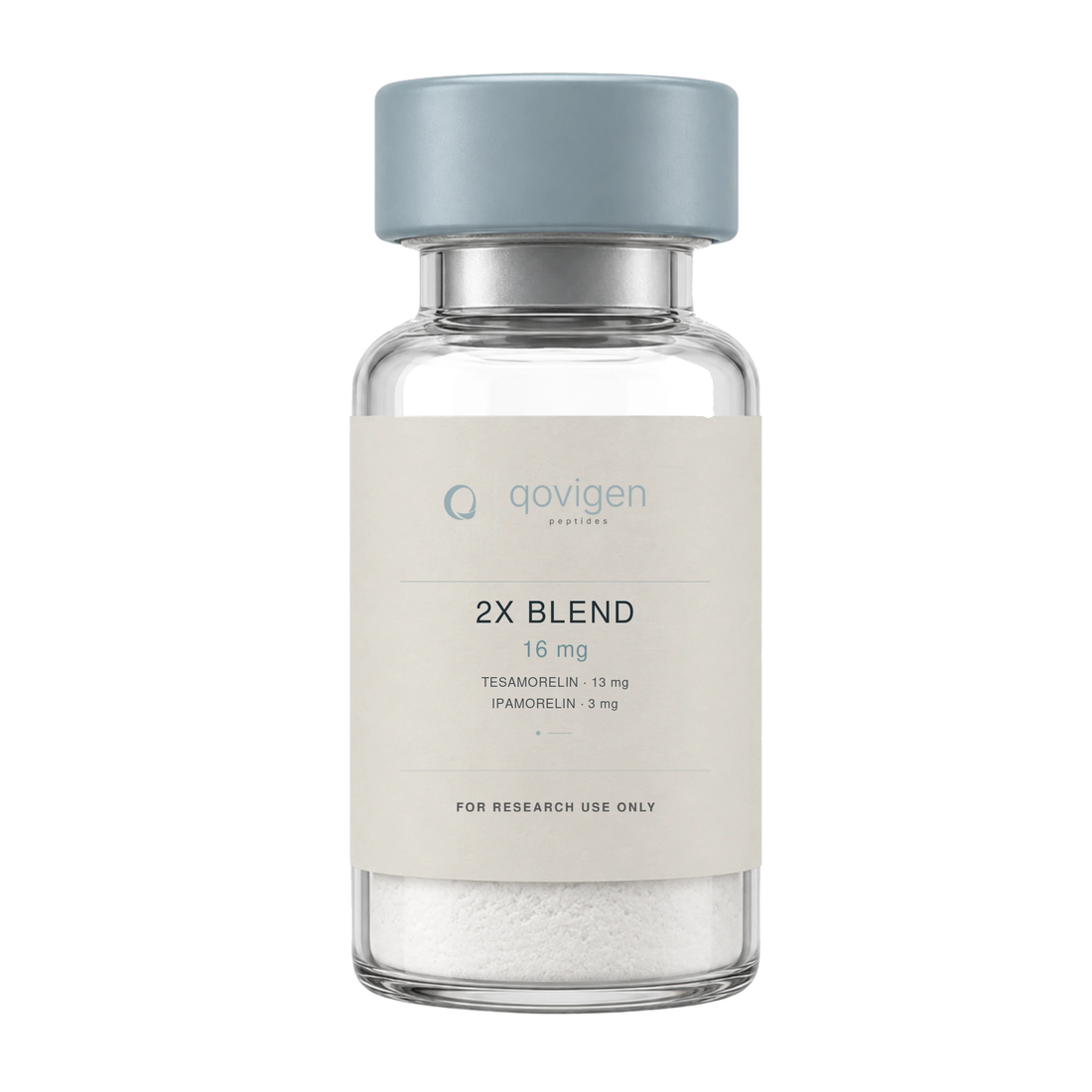
Tesamorelin 13 mg + Ipamorelin 3 mg
Two Secretagogues, Two Receptors, One Vial
The 2X Blend pairs Tesamorelin, a stabilised analogue of growth hormone-releasing hormone, with Ipamorelin, a highly selective ghrelin-receptor agonist. The two act on different receptors on the same pituitary cell, which is the whole point of combining them.
- 16 mg total: Tesamorelin 13 mg + Ipamorelin 3 mg
- Tesamorelin: GHRH(1-44) analogue, acts at the GHRH receptor
- Ipamorelin: pentapeptide Aib-His-D-2-Nal-D-Phe-Lys-NH2, acts at the GHS receptor
- Two independent pathways converging on the somatotroph
- Ratio weighted toward the GHRH arm, unlike an even 1:1 blend

Two Distinct Receptor Systems
Why the Two Components Are Not Interchangeable
Tesamorelin is a GHRH(1-44) analogue engineered for stability; in phase 3 trials it raised IGF-I by around 81% versus a 5% fall on placebo. Ipamorelin comes from a different lineage entirely — it was identified by removing the central Ala-Trp dipeptide from GHRP-1, and it is notable for what it does not do: at doses more than 200-fold above its ED50 for GH release, it did not raise ACTH or cortisol.
- Ipamorelin acts through a GHRP-like receptor, confirmed with GHRP and GHRH antagonists
- No effect on FSH, LH, prolactin or TSH in swine
- Selectivity for GH release comparable to GHRH itself
- Tesamorelin raised IGF-I by ~81% over 26 weeks in a 412-patient trial
- GHRH-receptor and GHS-receptor arms can be dissected pharmacologically
Research Applications
Where Each Component Has Actually Been Studied
The two halves of this blend come with very different evidence bases, and it is worth keeping them separate. Tesamorelin has large randomised human trials; Ipamorelin has detailed preclinical pharmacology.
- Visceral adipose tissue quantified by CT scan over 26 and 52 weeks
- Triglycerides, total cholesterol and cholesterol/HDL ratio
- IGF-I response and glucose parameters
- GH release from primary rat pituitary cells (EC50 and Emax)
- Dose-response in anaesthetised rats and conscious swine
- Hormone-selectivity panels: ACTH, cortisol, FSH, LH, prolactin, TSH
- Radioligand binding at the human type 1A GHS receptor
The Science Behind the 2X Blend: Two Well-Characterised Peptides, Deliberately Unequal
The 2X Blend combines two growth hormone secretagogues that reach the same cell by different doors. Tesamorelin is a stabilised analogue of GHRH(1-44) and binds the GHRH receptor. Ipamorelin is a pentapeptide that binds the growth hormone secretagogue receptor — the ghrelin receptor. Because the receptors are independent, the two arms can be studied together or separated pharmacologically.
The 13 mg / 3 mg ratio is deliberate and worth noting: this is not an even split. The blend is weighted heavily toward the GHRH arm, with Ipamorelin present at roughly a fifth of the Tesamorelin dose.
Tesamorelin carries the larger clinical dataset. A 412-patient randomised trial published in the New England Journal of Medicine reported a 15.2% decrease in visceral adipose tissue against a 5.0% increase on placebo over 26 weeks, with IGF-I up 81%. A 52-week extension and a pooled analysis of two phase 3 trials, together covering 806 patients, reported that the visceral fat reduction was maintained on treatment — and, importantly, that it did not persist after treatment stopped.
Ipamorelin is characterised preclinically rather than clinically, and its defining property is selectivity. The 1998 paper that introduced it showed GH-releasing potency comparable to GHRP-6 in rat pituitary cells, anaesthetised rats and conscious swine — while, unlike GHRP-6 and GHRP-2, producing no rise in ACTH or cortisol even at doses more than 200-fold above its ED50. No effect was seen on FSH, LH, prolactin or TSH.
For research teams investigating the GH axis, receptor cross-talk between GHRH and ghrelin signalling, or dose-ratio effects in combination secretagogue protocols, this blend provides two thoroughly documented components in a fixed, asymmetric ratio.
For research use only. Not for human consumption.
Scientific Literature
- Falutz J, Allas S, Blot K, et al. Metabolic effects of a growth hormone-releasing factor in patients with HIV. N Engl J Med. 2007;357(23):2359-70.
- Falutz J, Allas S, Mamputu JC, et al. Long-term safety and effects of tesamorelin, a growth hormone-releasing factor analogue, in HIV patients with abdominal fat accumulation. AIDS. 2008;22(14):1719-28.
- Falutz J, Mamputu JC, Potvin D, et al. Effects of tesamorelin (TH9507), a growth hormone-releasing factor analog, in HIV-infected patients with excess abdominal fat: a pooled analysis of two phase 3 trials. J Clin Endocrinol Metab. 2010;95(9):4291-304.
- Raun K, Hansen BS, Johansen NL, et al. Ipamorelin, the first selective growth hormone secretagogue. Eur J Endocrinol. 1998;139(5):552-61.
- Hansen BS, Raun K, Nielsen KK, et al. Pharmacological characterisation of a new oral GH secretagogue, NN703. Eur J Endocrinol. 1999;141(2):180-9.
Packaged with care, shipped fast.
The Qovigen Difference
2X Blend – Tesamorelin + Ipamorelin – 13 mg / 3 mg — Qovigen vs. a typical supplier.
Qovigen

2X Blend – Tesamorelin + Ipamorelin – 13 mg / 3 mg
Qovigen Peptides
Competitor

2X Blend – Tesamorelin + Ipamorelin – 13 mg / 3 mg
Typical Competitor
01 /
Higher Purity
02 /
Better Price
03 /
Faster Shipping
04 /
Verified Quality

After testing more than $8,500 worth of vials over the past year, Qovigen ranks first — set apart by genuinely new production technology.
Dr Aimen Arij
Doctor of Pharmacology · Lead Writer, dosagepeptide.com